Salt-Free Conditioners vs. Traditional Water Softener: What Tampa Homeowners Need to Know
Quick Summary: If your home has hard water, you may consider a salt-free conditioner as an alternative to a traditional water softener. While salt-free systems crystallize minerals to help reduce buildup, they do not remove hardness minerals such as calcium and magnesium from the water. Given Tampa’s moderate to very hard water levels, it is important to carefully compare a salt-free conditioner and a traditional water softener to determine which solution best fits your home.
If you live in the Tampa Bay area, you’ve probably noticed the signs of hard water: white scale on fixtures, spots on dishes, dry skin, and reduced appliance efficiency. Tampa’s municipal water supply is considered moderately to very hard, which makes choosing the right water treatment system especially important for homeowners. Over time, untreated hard water can lead to mineral buildup inside plumbing and appliances.
Two common solutions are salt-free water conditioners and traditional salt-based water softeners. While they may sound similar, they work very differently, and in Tampa’s hard water conditions, that difference matters.
What Is a Salt-Free Water Conditioner?
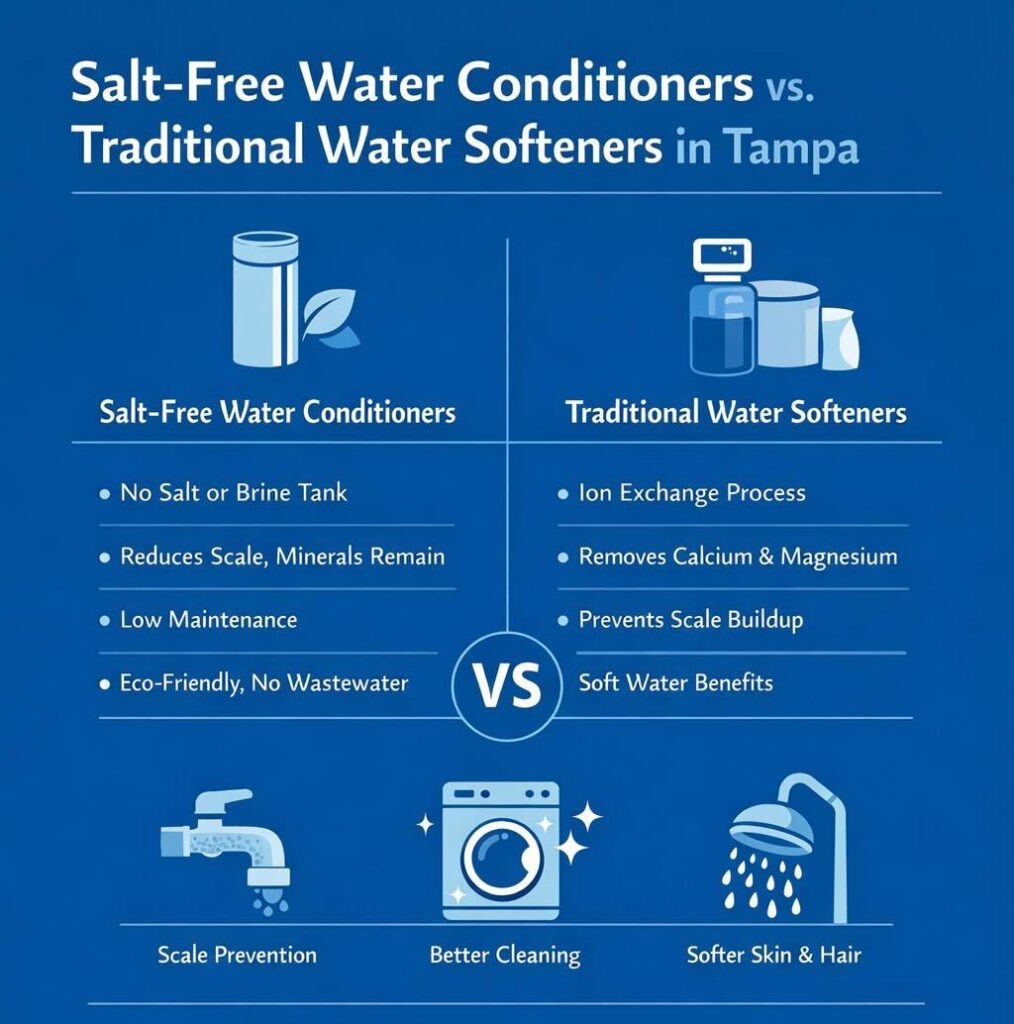
Salt-free conditioners, sometimes marketed as salt-free softeners, do not remove hardness minerals from water. Instead, most use a process called Template Assisted Crystallization (TAC), which converts dissolved calcium and magnesium into microscopic crystals that are less likely to stick to surfaces. This process can help reduce scale formation, but the minerals remain in the water and can still contribute to buildup over time.
What Salt-Free Water Conditioners Do Well
- Help reduce scale buildup in plumbing and appliances
- Require little maintenance, with no salt refills or regeneration cycles
- Do not add sodium to water
- Do not produce wastewater discharge
- Often have long service life with minimal upkeep
Because salt-free systems operate without salt, regeneration cycles, or brine discharge, they may reduce overall environmental impact compared to traditional softeners in certain households.
Limitations of Salt-Free Water Conditioners
- Do not fully remove calcium or magnesium
- Do not produce true “soft water”
- Soap may still struggle to lather effectively
- Hard water spots and soap scum may still occur
Salt-free systems condition water. They do not soften it, and they do not replace a true water softener in homes with moderate to high hardness levels.
What is a Traditional Water Softener?
Traditional water softeners use a proven process called ion exchange, which removes hardness minerals from water. The system captures calcium and magnesium, which cause hardness, and replaces them with sodium or potassium ions. Inside the tank, resin beads attract and hold these minerals until the system regenerates.
This process can remove up to 99 percent of hardness minerals, delivering soft water throughout the home and helping protect appliances such as water heaters from scaling damage. By reducing mineral buildup, a properly sized water softener improves efficiency and can extend equipment lifespan.
Benefits of Traditional Water Softeners
- Removal of calcium and magnesium
- Strong protection against scale buildup
- Improved soap lather and cleaning performance
- Reduced spotting on dishes and fixtures
- Softer skin and smoother hair
- Extended lifespan of appliances and plumbing
In Tampa homes with moderate-to-high hardness, many homeowners choose high-efficiency water softeners designed to remove hardness minerals, protect plumbing fixtures and appliances, and deliver consistently softened water throughout the home. A properly installed system helps prevent scale before it starts and improves overall water performance.
Because traditional softeners remove the minerals entirely, they provide a more comprehensive solution for Tampa’s water conditions.
Why Traditional Softeners Are Usually Better for Tampa Homes
With Tampa hardness averaging 11–12 gpg and reaching up to 17 gpg seasonally, traditional softeners outperform salt-free conditioners in several key areas, especially where hard water is consistently present.
Superior Scale Prevention
Traditional softeners remove the minerals that cause limescale, protecting:
- Water heaters, both tank and tankless
- Dishwashers and washing machines
- Plumbing and fixtures
Salt-free conditioners do not significantly improve cleaning performance because hardness minerals remain in the water.
Improved Cleaning & Soap Performance
Hard water interferes with soap and detergent effectiveness. With softened water:
- Soap lathers better
- Laundry and dishes come out cleaner
- Less detergent is required
- Soap scum and residue are reduced
Salt-free conditioners do not offer the same improvement because the minerals are still present.
Everyday Water Comfort
Many Tampa homeowners prefer traditional softeners because they notice:
- Softer skin and smoother hair
- Less spotting and mineral film
- Reduced buildup on glass, fixtures, and shower doors
Salt-free systems cannot replicate these soft water benefits, which is why many households eventually upgrade to a full water softener solution.
When Would a Salt-Free Conditioner Make Sense For My Home?
While traditional softeners are usually the better choice in Tampa, salt-free conditioners can make sense in certain situations:
- Homes with mild hardness, below about 7 to 8 gpg
- Homeowners who want a low-maintenance system
- Areas with water softener discharge restrictions
- Households wishing to avoid added sodium
In most Tampa homes, where hardness regularly exceeds 10 gpg, salt-free systems do not fully resolve hard water problems and may not match the performance of a properly sized water softener.
Cost, Maintenance, & Lifespan
Both systems offer different advantages depending on household preferences.
Salt-Free Conditioners
- Very low maintenance with no salt or regeneration
- No wastewater discharge
- Often longer lifespan
- Limited performance in harder water
Traditional Water Softeners
- Require periodic salt refills
- Typically last 10–15 years
- Provide complete hardness removal
- Deliver stronger protection and performance
For Tampa homeowners dealing with noticeable scale and soap inefficiency, the performance benefits of a traditional water softener often outweigh the added maintenance.
Tampa’s Water Source & Hardness Levels
Tampa’s drinking water primarily comes from the Hillsborough River, supplemented by groundwater and regional supplies from Tampa Bay Water when needed. These sources contain naturally occurring calcium and magnesium, which cause water hardness.
According to Tampa’s most recent water quality report, the local water supply is classified as hard to very hard, with an average hardness level of approximately 185 to 201 mg/L, or about 11 to 12 grains per gallon. Hardness can fluctuate seasonally, typically ranging from 140 to 300 ppm, or 8 to 17 gpg). At these levels, hardness becomes noticeable and begins impacting plumbing, appliances, and daily water use.
Homeowners dealing with persistent scaling often find that untreated hard water gradually reduces appliance efficiency and leaves visible residue throughout the home. Many choose to combine a high-efficiency water softener with advanced water filtration for broader water quality improvement and added protection.
Which Softening System Should Tampa Homeowners Choose?
Salt-free conditioners and traditional softeners serve different purposes. Salt-free systems alter hardness minerals but do not remove them, which limits their effectiveness in Tampa’s hard to very hard water conditions.
With Tampa hardness averaging 11 to 12 gpg and sometimes reaching 17 gpg, traditional water softeners provide stronger protection against scale, better cleaning performance, and soft water throughout the home.
If you are unsure which system is right for your home, Culligan offers a free in-home water test to confirm what is coming out of your faucets and identify what can be improved. Local Florida water experts can then recommend customized treatment solutions tailored to your home, delivering better water from every tap.